
Track less. Get more.
No own analytics cookies · EU data · privacy-minded Runs alongside GA4 and Matomo · nothing to switch off Server-side modules without JS · less consent-dependentAnalytics for online stores.
No own analytics cookies.
Trackless measures your online store's traffic and actual revenue right on the server - without its own analytics cookies, without data sampling, and designed with GDPR in mind. It runs alongside Google Analytics and Matomo, so there is nothing to switch off: keep GA4 running and compare the numbers at your own pace.
Connections: PrestaShop ↗ WordPress / WooCommerce ↗ Shoptet ↗ Eshop-rychle ↗ Upgates ↗ more platforms ↗ API ↗
Your data stays yours · No sharing with ad networks
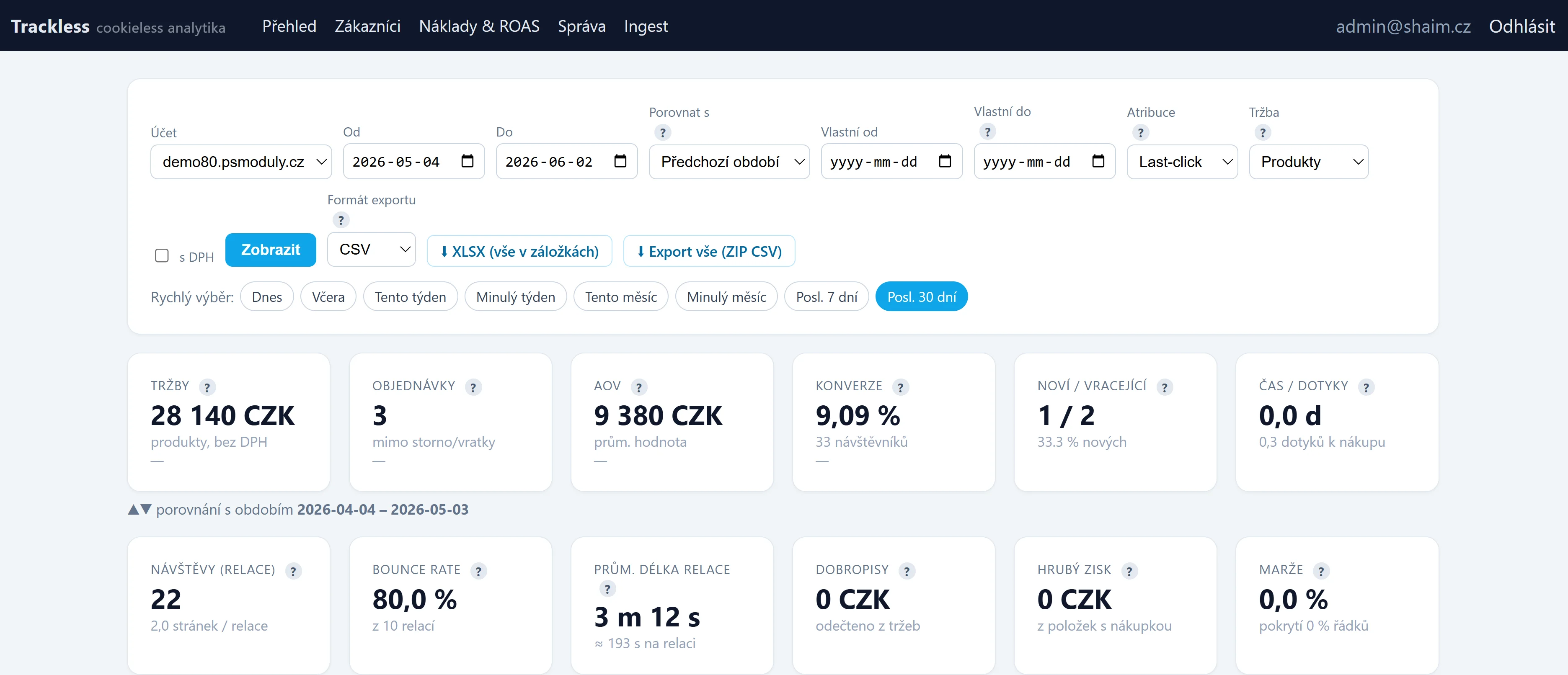
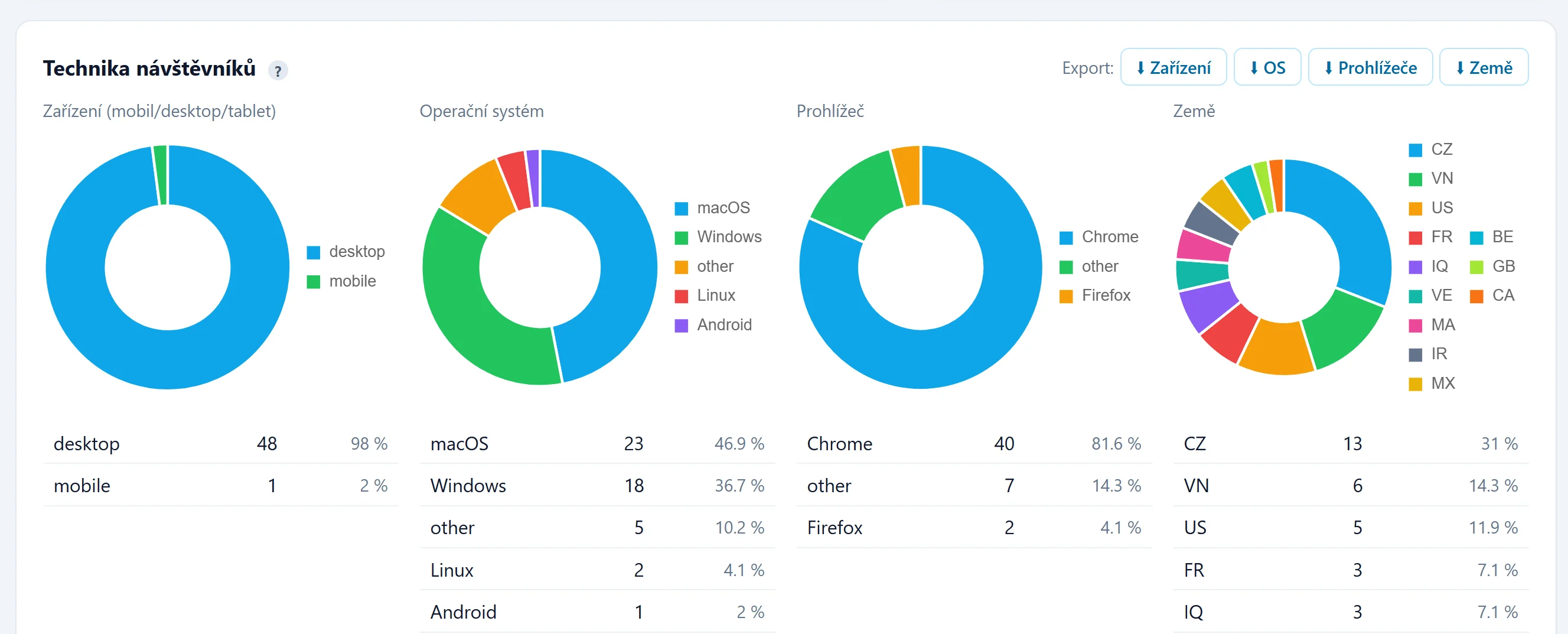
A look at the dashboard
Server-side and cookieless - yet a full dashboard.
What Trackless does
Online store metrics that make sense - from traffic through actual revenue to margin and ROAS.
No own analytics cookies
Measurement runs on the server through a ready-made module, plugin or API. For analytics itself you can usually work without your own analytics cookies; cookie banners and consent still need to be assessed for the whole site. Server-side measurement typically reduces data loss from rejected consent.
Integration by platform
Server-side modules and plugins cover PrestaShop, WordPress/WooCommerce, Joomla / VirtueMart, OpenCart, Magento 2, Shopware 6 and Sylius; Forga has native Trackless measurement built in. Shoptet, Eshop-rychle, Upgates, Webareal, Webnode, Shopify, FastCentrik, Mioweb and Nody connect through a tracking snippet; custom builds use the API.
Actual revenue and margin
Net revenue after cancellations and returns, margin from purchase (wholesale) prices, products, categories and ROAS from imported ad spend. Instead of raw turnover, you see performance numbers you can actually use for decisions.
Attribution across days
We connect visits and orders by customer and across days - so you see which channel actually drives sales.
Behaviour and content
Purchase funnel, top products and categories, landing and exit pages, internal search and 404 errors.
Customers and LTV
New vs. returning, customer value over time and an overview of your best customers.
How it works
Setup takes a few minutes, with no extra server on your side.
Connect your site
Use a server-side module or plugin where the platform allows it, a tracking snippet for hosted platforms, or the API for custom builds.
Add the key or tracking snippet
Add a site in the Trackless app. For a server-side module or API integration, copy that site's own api_key; these requests are signed (HMAC). For browser measurement, use the supplied tracking snippet with its public token. Each site has its own connection; never put the secret api_key in the browser.
Watch the data
Visits and orders flow into a clear dashboard. No sampling, your own data.
Trackless vs. GA4, Matomo, Plausible & Fathom
An honest comparison. Every tool has its place - Trackless focuses on online stores and privacy.
| Feature | Google Analytics 4 | Matomo | Plausible / Fathom | Trackless |
|---|---|---|---|---|
| Less dependent on cookie consent | ✗ | △ | ✓ | ✓ |
| No data sampling | ✗ | ✓ | ✓ | ✓ |
| Your own data, no sharing with ad networks | ✗ | ✓ | ✓ | ✓ |
| Actual revenue after cancellations and returns | △ | △ | ✗ | ✓ |
| Margin from purchase (wholesale) prices | ✗ | ✗ | ✗ | ✓ |
| ROAS from ad spend | △ | △ | ✗ | ✓ |
| No self-hosting or maintenance | ✓ | △ | ✓ | ✓ |
| Ready-made store / website integration | △ | △ | △ | ✓ |
| Measures even without JavaScript - with server-side modules | ✗ | △ | ✗ | ✓ |
| Cookieless order attribution across days and by customer | △ | △ | ✗ | ✓ |
| Customer lifetime value (LTV) and top customers | △ | ✗ | ✗ | ✓ |
| Data in the EU and direct support | ✗ | △ | △ | ✓ |
| Ongoing overview (freshness depends on integration) | △ | ✓ | ✓ | ✓ |
| Free of charge | ✓ | △ | ✗ | ✗ |
| Google Ads and remarketing integration | ✓ | ✗ | ✗ | ✗ |
| Heatmaps and session recording | ✗ | ✓ | ✗ | ✗ |
✓ yes · △ partial / with limits · ✗ no
To be fair: GA4 is free and integrates superbly with Google Ads; Matomo is open source with full control over your data (when self-hosted). Trackless is focused on online stores - cookieless measurement plus real revenue, margin and ROAS, without your own infrastructure.
Looking for a cookieless alternative to Plausible, Fathom, Simple Analytics, Cloudflare Web Analytics or Umami? Trackless measures cookielessly just like them, but adds e-commerce depth (revenue, margin, ROAS) on top.
Pricing
Online stores pay by order volume, traffic-only websites by visits. We invoice once a year - you know the price up front; any durable band overrun is handled in advance and only as a pro-rated top-up.
Only completed (paid) orders from the last 12 months are counted. Don't know the number? During the 30-day trial we show you the band from real data; any durable band overrun during a paid period is handled in advance and only as a pro-rated difference.
Online store - by orders per year
The online store plan includes everything from traffic plus orders, revenue (after cancellations/returns), margin from purchase prices, ROAS, products, categories, funnel and customers.
Static website - by traffic
Cookieless traffic: sources and channels, top pages, devices, countries, search, 404. For blogs, company sites and landing pages.
Prices are per website/online store per year, excl. VAT. Billed once a year after the 30-day trial - the monthly figure is just a reference. Your band is set from real data (for a new store, from its annualised pace). If you durably outgrow your band mid-year, we warn you in advance and charge a pro-rated difference for the rest of the period (not a full year); if orders drop, the lower price applies at renewal.
Frequently asked questions
Do you share or use the data?
No. The data is yours alone - we don't use it for advertising and don't pass it to third parties beyond what's needed to run the service (hosting, backups).
How does it connect?
It depends on the platform: a server-side module/plugin for open-source stores, a tracking snippet for hosted platforms, or a simple API for custom builds.
Can I export my data?
Yes - anytime from the dashboard to CSV, XLSX or JSON (traffic and e-commerce metrics). Your data, no lock-in.
Do I need a cookie banner?
There is no one-size-fits-all answer. Trackless itself does not store its own analytics cookies in the browser. The legal basis, information duty and cookie banner should always be assessed for your specific implementation and other tools on the site.
Does it work without an online store?
Yes. On an ordinary website (WordPress or anywhere else) you measure traffic; e-commerce metrics appear only once you have orders.
Where is my data stored?
On servers provided by Hetzner in Germany, within the EU. Hetzner Online GmbH provides the server and database infrastructure, including operational backups; the service continues to be operated by Czech-based OpenServis.
What if I have several websites?
Under one account you can have several websites and online stores and switch between them in a single overview. The price is calculated per website per year.
How does Trackless handle GDPR?
Trackless is designed for analytics with GDPR in mind: pseudonymous, minimised data (no names/e-mails), does not store the raw IP in analytics data in its original form, uses only a salted fingerprint and with the tracking JavaScript processes the IP only transiently while handling the request. The website operator still needs to choose the legal basis, fulfil the information duty and assess the cookie banner for their deployment. A data processing agreement (DPA) is available.
Why by orders, and not by visits?
You know your order count - traffic usually not. Order count also matches the value the measurement brings you better: the more you sell, the more there is to analyse.
Will Trackless slow my site down?
Server-side modules store events in a local queue during a visit and send the data in background batches. The interval and sending mechanism depend on the integration; not every module sends only once a day. This reduces network transfers during a visit. The modules add no custom tracking script to the browser, but server processing and database writes have some overhead. The actual effect on speed and Core Web Vitals depends on the site and hosting. The tracking snippet for hosted platforms (Shoptet, Eshop-rychle and the like) loads asynchronously.
What counts as an order?
Only completed and paid orders, after subtracting cancelled and returned ones. Abandoned carts and cancelled orders do not count. And on a rolling last-12-months basis, not by calendar year.
Do I get fewer features on a cheaper plan?
No. Every band gives you absolutely everything - revenue, margin, ROAS, attribution, sources and customer journeys. Only the number of orders the plan covers differs. The available modules and plugins are free on top.
What if I outgrow my band?
Measurement keeps running, we switch nothing off. A brief spike over your band is ignored. If you stay above it, we warn you in advance and charge only the pro-rated difference for the rest of the period (not a full year); from the next annual renewal you simply pay the higher band's price. If orders drop, the lower price applies at renewal.
Do I have to leave GA4 for Trackless?
No. Run Trackless and GA4 side by side - they do not exclude each other. Keep GA4 running (remarketing, Google Ads) and add Trackless as an independent server-side view of revenue and margin that can also capture visits GA4 does not see. No migration, nothing to switch off; in time you decide whether to keep GA4.
What is the difference between visits, visitors and views?
A view is each page open. A visit (session) is one visitor's activity within one fixed 30-minute block (not a rolling 30 minutes from the last activity). A visitor (unique) is one daily cookieless fingerprint derived from the IP address and browser; it does not necessarily represent one person. One fingerprint can have several visits and views. Over longer periods, visitor counts sum daily uniques rather than count distinct people across the whole period.
Can you recognise a returning visitor after several days?
Not as one persistent visitor profile. The daily visitor fingerprint changes and Trackless stores no own measurement identifier in the browser. For order attribution, it may connect visits and orders inside the configured attribution window using internal store data (for example customer/cart) and limited pseudonymous technical data. Returning customers are therefore best evaluated from orders and repeat purchases, not as an advertising profile of a person across days.
How long do you keep the data, and what happens after I close my account?
Your statistics - traffic, revenue, channels and individual orders - are kept for the whole time your account is active, so you can compare trends year over year; none of it disappears after 180 days. Only the raw records of individual visits and events (used for the detailed funnel and drill-downs) have a time limit - we prune them after roughly 180 days, but your summary figures are unaffected. When you close your account, we irreversibly delete all your measured data within 30 days; only issued invoices are archived for the legally required period.
When can legitimate interest be considered?
For server-side modules the measurement runs on the store server; for hosted platforms we use a lightweight browser snippet. In both cases Trackless stores no own analytics cookies or own measurement identifier in the browser, does not collect names, e-mails or precise location, and does not store the raw IP in analytics data in its original form; with the browser snippet it processes the IP only transiently while handling the request and works only with pseudonymous technical data. For this kind of minimised analytics, legitimate interest can often be assessed under the GDPR, but it is not automatic. The concrete assessment, information duty and cookie banner always depend on your deployment; details are covered by the data processing agreement (DPA).
How does browser-side blocking affect measurement?
With server-side modules, measurement happens directly on the store's server, outside browser scripts. On hosted platforms (Shoptet, Eshop-rychle and the like) we use a lightweight browser snippet; in normal setups Trackless is not usually blocked, but under aggressive blocking of measurement scripts, some visits may be missed.
I have several e-shops - how do I add them?
After signing in, go to My sites and click Add site. You measure each e-shop as a separate site with its own measuring key (api_key), so the data of individual e-shops never mixes and you can switch between them easily.
Does one key measure only one e-shop?
Yes - each site has its own api_key, so one key measures one e-shop. The exception is a single PrestaShop multistore installation (several domains under one admin), which can share one key and is told apart by its internal shop id.
How do advertising costs get into Trackless?
Upload advertising costs in the app from a CSV with date, source, medium, cost and optional currency. Trackless matches them with revenue and calculates ROAS. The public demo opens in one click without registration or a password.
Can I give a client or colleague read-only access?
Yes. Share access by e-mail to one site or an entire group. The recipient can view dashboards, reports and exports, but not invoices, account settings or the site's connection; management and billing remain with the owner.
How does Trackless group sources into channels?
Trackless automatically groups visits from UTM parameters, gclid/fbclid and the referrer into fixed GA4-style groups such as organic or paid search, social, e-mail, AI, referral and direct. Custom rules cannot currently be configured; returns from common payment gateways and links from the site's own domain do not overwrite the original source.
Who is behind Trackless
No faceless startup - behind Trackless is a person who has lived in e-commerce and PrestaShop for over 15 years.

Dominik Shaim Ulrich
Official PrestaShop Committer · e-commerce developer
I run a specialised PrestaShop hosting service, OpenServis (since 2009), develop modules at PSModuly.cz, a newsletter service, SmartMailer, and the hosted e-shop platform Forga. Trackless is a natural continuation - analytics for online stores that I wanted for myself: honest, cookieless and Czech-made. It also measures our own sites (OpenServis, PSModuly, SmartMailer), so we rely on it ourselves every day. Behind it all is a real person and company - Dominik Ulrich, trading under the OpenServis brand - not an anonymous app.
Building websites and e-shops for clients? Recommend Trackless and earn
For agencies, freelancers and web builders - we pay a commission for every e-shop you refer on a paid plan, and for every referred customer both sides get 30 free days.
One-time commission
When a referred e-shop pays its first regular invoice for a paid plan, you earn a one-time commission shown directly in the partner program. Static websites are excluded from the commission - the reward for them is free days.
30 free days for both
The new customer gets 30 free days and, after their first payment, we add the same bonus to your own plan.
One link, overview in the app
Share your link, see registrations and commissions in the app, and do not calculate anything manually.
Cookieless analytics for online stores
Briefly and plainly - what Trackless is and who it makes sense for.
Trackless is Czech analytics without own analytics cookies built for online stores. Measurement runs on the server and without own analytics cookies. Consent and cookie-banner handling should always be assessed against the whole site setup. Connect it with a server-side module or plugin for supported stores, with a tracking snippet for hosted platforms, or via the open API for custom builds.
Treat it as a practical alternative (or complement) to Google Analytics 4 and to tools like Matomo, Plausible or Fathom - focused on privacy and on the numbers that really matter in e-commerce. Instead of mere visits you see actual revenue after cancellations and returns, margin from purchase prices and ROAS, the purchase funnel, top products and customer value over time.
The data stays yours, stored in the EU, with no sampling and no sharing with ad networks. Privacy-conscious, in line with GDPR, with direct support. You can try it free for 30 days, with no commitment.
Start measuring without own analytics cookies today
30 days free, then from 12 €/year (website) or from 49 €/year (online store, by orders), excl. VAT.
Try it free